
Glossary for Users
Rev 1: Feb 25, 2026
Authors: Parvathy V and Sanjna GY
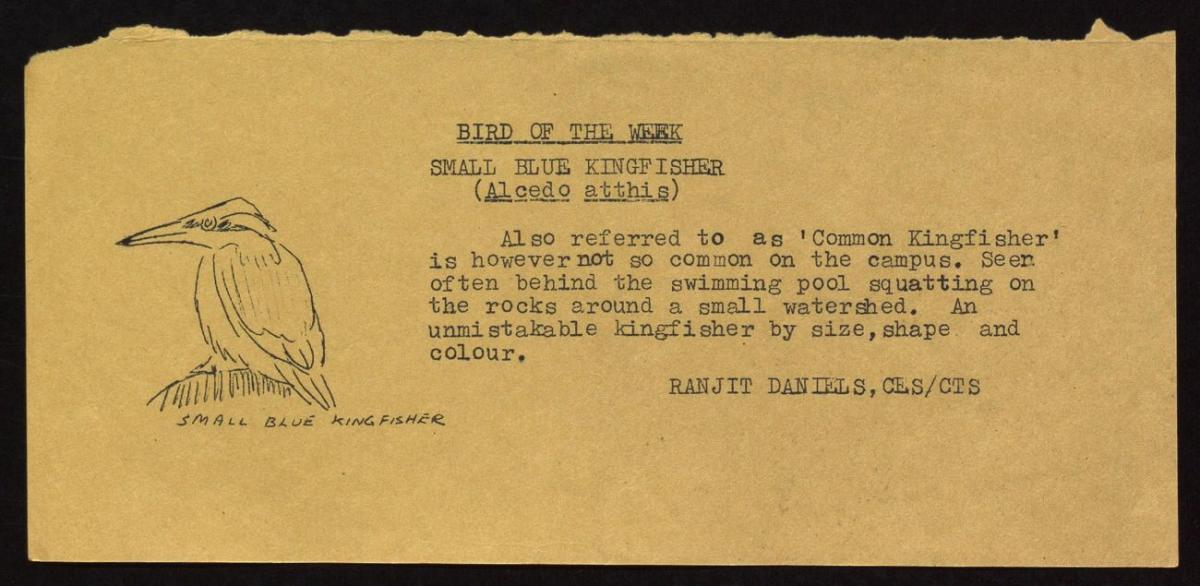
Bird of the week, 1984. MS-019-1-6-7-9, RJ Ranjit Daniels Papers, Archives at NCBS
Stepping into an archive introduces the user to multiple ways of organising, arranging and classifying historical records.
Here is an introductory glossary of commonly used terms at the Archives at NCBS, which will help you use the guides we have created and navigate through the archive.
1) Catalogue: Think of our catalogue as a search engine for everything the Archives at NCBS holds. It acts as a descriptive compilation of archival material used to identify, manage, and provide access to records within an archive.
2) Collections/Papers: The term collections and papers are used interchangeably in our Archives, to refer to materials assembled by a person or organization from a variety of sources. There are two main types of collections which the Archives at NCBS hosts - custodial and post-custodial.
Custodial collections refer to archival material housed physically and digitally at the Archives and take the following forms:
- Material donated by individuals or organisations. For example: P.C. Vaidya Papers (individual) and Environmental Support Group (organization)
- Some collections, which are smaller in volume, bring together material from different individuals on a subject and are organised as “Small Donations”. For example: Small Donations - Agricultural Sciences
- Oral Histories. For example: Oral Histories of Ecology and Conservation consisting of 46 interviews with scientists and practitioners
- Rare scientific artefacts collected from laboratories. For example: Artefacts collected from the laboratory of Obaid Siddiqi
Post-custodial collections refer to only digital copies of archival material hosted on our catalogue take the following forms:
- Materials from the Program for the Archiving of Science and Technology (PAST), which works with organizations to archive and digitize objects from communities and groups. While our other collections are primarily donated by individuals or their families, the PAST collections are gathered from multiple sources.
- Material from other repositories such as St. John’s National Academy of Health Sciences and Azim Premji University Archives. For example: Editions of the Vigyan Karmee and Journal of the Association of Medical Women in India
3) Series, sub-series and folder: To preserve the context of how records were originally created and kept, archival materials are organised hierarchically within a collection, moving from broad categories to specific items. The highest level of arrangement is the series, a sub-series is a more specific subdivision within a series and a folder is the lowest level of hierarchy at our Archives, which houses the archival object. When you request to view material, you typically request a folder that holds an archival object.
4) Identifier: We give each archival object a unique alphanumeric address to ensure we can accurately locate, retrieve, and cite it called the identifier. In our Archives, the identifier for an object reflects the position of an object in the collection and consists of the series, sub-series, box and folder number.
Based on the types of collections described above, the format of identifiers can take the following forms:
MS-013-2-1-4-19
SD-003-1-1-1-11
OH-003-32-1
AT-003-001
AR-005-1-1-1-1
LB-001-1-1
The form for requesting an item requires the user to note the identifier for an object from the catalogue
5) Digital object: The archive digitises its collection for both access and preservation. The Archives at NCBS is committed to open access while balancing considerations of sensitivity and privacy. Folders that are openly accessible via our catalogue are called digital objects and can be accessed by users through the catalogue. For folders without a digital object, users can contact the archives. Email us at archives@ncbs.res.in
However, please remember that access is different from use! To understand this better and to figure out conditions governing use of material, see https://archives.ncbs.res.in/access



