
Program for the Archiving of Science and Technology (PAST) -- Cohort 2
Call for Project Proposals
2027-28
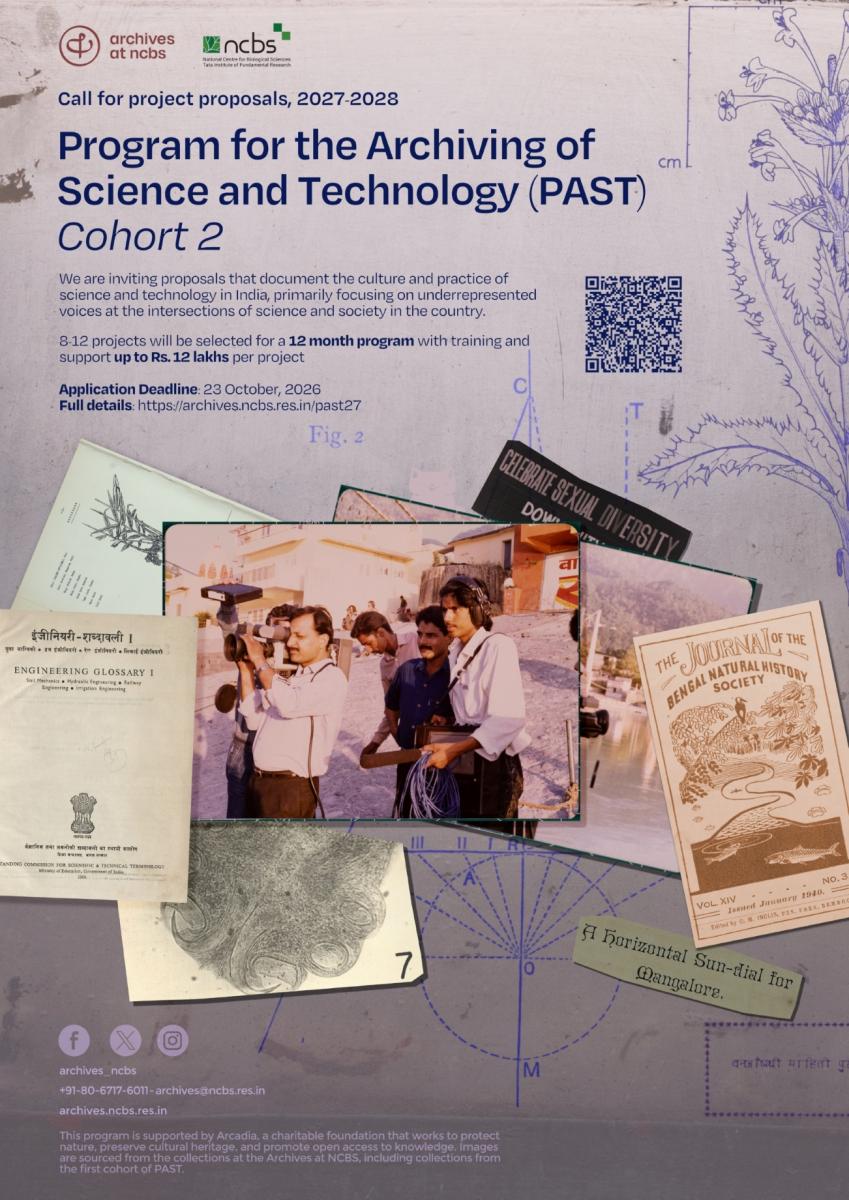
The Program for the Archiving of Science and Technology (PAST) is a flagship program of the Archives at NCBS aimed at digital preservation of, and enabling digital access to, at-risk archival material. It is a 12-month program for archival appraisal, standards-compliant archival description, digitization and digital preservation, and mirroring of archival data at the Archives at NCBS. PAST features year-long training, funding support, expert inputs and guidelines, skill development exercises, and more.
Eight projects participated in PAST Cohort #1 (2025-26), resulting in 26 collections. Project catalogues and digital assets were made accessible to the public in February 2026 and are compiled here.
The Archives at NCBS is pleased to announce the application process for the second cohort of PAST. We invite applications for projects to enable digital access to archival material that are rare, endangered, of archival value, and related to the history of science and technology in contemporary India (approximately between 1850 and 2000). The program focuses on under-represented and marginalised histories in science-technology-engineering-mathematics/medicine (STEM). Each project should typically outline names for three roles:
- An individual lead applicant (referred to as “Lead Applicant”) who is an Indian citizen.
- A Host Organisation, legally registered in India, to collaborate with for archiving and digitization for collections identified
- An archival source for the material (referred to as “Source”), which could also be the host organisation
Budget: Up to Rs. 12,00,000 (Twelve lakhs) inclusive of all taxes. Funding support is provided for the following expenses:
1. Project personnel costs (including lead applicant and/or persons selected by the Lead Applicant). All project personnel will be hired directly by NCBS for the duration of the project. This should be at least 50% of the total amount.
2. Up to INR 6 lakhs will be covered towards expenses for accession, processing, and digitization of identified material.
Applications Open: 14 September 2026
Online Information Sessions: 4:00 PM IST on 21 September 2026, 30 September 2026, 15 October 2026. Register for the online information sessions at: https://ncbs-res-in.zoom.us/meeting/register/iRDTAe5uS1eEqRhyGUlucg
Application Deadline: 23 October 2026
Announcement of Final Projects: 15 January 2027
Cohort 2 Project Timeline: 01 February 2027 to 31 January 2028
The Archives at NCBS is committed in engaging with ways to drive diversity, equity, and inclusion. We would be happy to provide information about the program in a language other than English. Please contact archives@ncbs.res.in if you need help translating the form or have an idea, but are uncertain whether it would fit. We are happy to help you out!
Full details on the call for proposals below, and also available as an information booklet (click here for PDF)
If you have questions, write to us: archives@ncbs.res.in
Submission form: Click Here
This program is supported through generous funding from Arcadia Philanthropic Trust, UK, a charitable foundation that works to protect nature, preserve cultural heritage and promote open access to knowledge. Since 2002, Arcadia has awarded more than $1.3 billion to organisations around the world.
Document history (any updates on this page after initial call will be summarized here):
Rev 0 (Mon, Sep 14, 2026): Original version
*****
Detailed Call for Project Proposals
Introduction
The Archives at NCBS invites applications for projects to enable digital access to collections that are rare, endangered, and of archival value. The program’s scope focuses on histories from:
- STEM (Science, Technology, Engineering, Mathematics/Medicine)
- underrepresented and/or marginalised groups in STEM
- contemporary India (approx. 1850 - 2000)
The program aims to identify and preserve scientifically vital archival records that are at-risk and often overlooked from representation in archives.
Key components of the program:
- Lead Applicant will identify archival material relevant to the scope of the program
- Selected projects will receive training to carry out accession, processing, and digitization of identified material through regular, structured training meetings and reviews
- Selected projects will receive funding support towards various aspects of digital preservation and enabling digital access to the archival collections
- The original archival material will stay at its place of origin/Source or with the Host Organisation
- A copy of the digital material will be part of the digital archive run by the Archives at NCBS
PAST will aim to support various projects in local skill development, archival description in alignment with international and local archival standards, and enabling digital access and long-term preservation of digital items from each project for posterity.
About the Archives at NCBS
The Archives at NCBS is a public collecting centre for the history of science in contemporary India (HOSCI). It has over 4,00,000 objects in over one hundred collections. The material includes various forms, ranging from paper-based manuscripts to negatives to photographs, books, fine art, audio recordings, scientific equipment, letters, and field and lab notes. The 2000-square-foot state-of-the-art physical centre at NCBS includes space for research, processing, exhibitions, recording, and a leading-edge storage facility with monitors for temperature, light, humidity, air quality, water, fire, pests, and noise. In addition to the physical centre, we also run a digital archive, and digitized collections from PAST projects become a part of it. Currently, there are 26 such PAST collections from the first cohort, for which we serve as a post-custodial archive, and hold only the digital objects.
Scope of the Program
We encourage proposals that document the culture and practice of science and technology in India, primarily focusing on underrepresented voices at the intersections of science and society in India.
Selected projects can deploy efforts toward any or all of the following: material survey, digitization, archival appraisal, cataloguing, description and arrangement, digital media transfer, physical conservation of select material to enable digital access, image processing, data storage, and more. Projects would survey and evaluate the archival material either before applying for the program or in the first month after receiving the award. They will need to manage and catalogue the material per archival standards, create metadata (content descriptions for archival objects in the collection), and handle imaging and creation of the digital assets in the collection. The end goal is enabling free, public digital access for the project through the website of the Archives at NCBS. This material must be catalogued in our online digital archive in a standard archiving format.
Archival material could be rare printed material, unique and original material such as manuscripts, maps, ephemeral objects, and audio-visual material such as recordings, photographs, micro-film, film, and more. Collections could include digitised and born-digital data. It may include data stored in obsolete technology - such as videotapes, audio tapes, CDs, micro-film, and more.
We are interested in interdisciplinary collections that focus on fields and topics such as the history of science, technology, and medicine in contemporary India. These include material related to particular scientific disciplines and scientific research, scientific resources and artefacts, material created to promote awareness about science, science education and communication, and non-academic activities related to science such as art, film, journalism, literature, and activism. This also includes community-driven approaches that do not always fit within the framework of science as practised at institutions, but are as relevant, if not more, a way to understand the culture of science and its practice in the country.
Funding Allocation and Number of Projects
Projects can have a maximum amount of Rs. 12,00,000 (twelve lakhs) inclusive of all taxes. Projects typically range from Rs. 6,00,000 (six lakhs) to 12,00,000 (twelve lakhs), for a duration of twelve months. The program will award between 8 and 12 projects.
Project personnel will be hired as PAST fellows of the Archives at NCBS. The project personnel can work at their own project site(s), as per project requirements.
Up to INR 6 lakhs may be used for various activities towards project outcomes, including but not limited to the following: digitization, digital media transfer, consultancy for archival processing, physical conservation of select material to enable digital access, material for image processing and storage.
Roles in the application:
Each project should typically outline the names for three roles:
- Lead Applicant: The lead applicant will be the designated point of contact for the PAST project. They will be responsible for execution of the project including archival processing, financial management, completion of the project and delivery of digital assets.
- Host Organisation: An organisation legally registered in India. Host Organisation will work with the Lead Applicant to carry out digitization of archival collections identified as per project requirements.
- A Source of archival material (which could also be the Host Organisation). The project can include archival material from across South Asia, but must be based out of India. Applicants must specify whether archival material of the project may be available within the host organisation or a distinct organisation (referred to as “Source”). It shall be the responsibility of the applicant and host organisation to ensure that they have the requisite permissions/agreements with the Source to utilise the materials for the PAST project. Also see Open Digital Access to Archival Material section below.
The project proposal should illustrate the ability to look after the physical archival material that is sourced, ideally housed with the Source or the Host Organisation. We encourage independent Lead Applicants to identify organisations that have access to or have archival material that relates to the history of science and technology in India from the past 200 years with an emphasis on underrepresented groups in STEM.
Eligibility Criteria
a) Lead Applicant should be an Indian citizen.
b) Host Organisations should meet the following requirements:
- Legally registered in India
- Has never been blacklisted by any government agencies
The lead applicant, host organisation, and/or source would hold a valid PAN card, and an Indian bank account.
The lead applicant, host organisation, and/or source would have prior experience in either archival work, history and culture of the subject area in line with the scope of PAST 2027-28, or subject expertise in material being planned for the project.
NCBS may demand documentary proof of these conditions during the review process.
Material Eligibility: Culture of science in India and under-represented histories
The archival material should be related to the culture and history of science and technology in contemporary India, between 1850 and 2000. It must be at-risk material of archival value that will benefit from open digital access.
Project proposals would document underrepresentation in STEM in India along aspects of history, culture, politics and practice of science in India. They would feature material from marginalised groups in science, along one or more of the following categories that have been historically underrepresented in archives and repositories in India:
- focused on marginalised social groups and communities in science
- enables representation of genders and minority groups in science
- material in English as well as languages other than English
- material that highlights local histories of science in under-represented regions
- citizen and community engagement with science
- material from administrative, technical and support staff and scientific workers
- science related movements and groups
- material at the intersection of social change, social justice in science
- material relating to the social and ethical impact of science
- science communication and popularisation
PAST projects are typically expected to consent to have most of their material categorized as Access Level 1: Open/Online. To know more about conditions governing access and use for material in the Archives at NCBS, refer to the Access and Use Guidelines page on our website and the 'Open Digital Access to Archival Material' section below.
Material older than 1850 can be considered if a justification is provided for how it extends our understanding of the culture of science in contemporary India. Material newer than 2000 can be considered under exceptional circumstances, only if it’s at-risk and archival value can be justified, along with the ability for all digital items to be made publicly accessible through our website. The material collection should emphasise underrepresented groups in STEM, ideally at the intersection of the history of science and society.
Type and format of material
The project collection may include written, audio or pictorial formats. It may consist of original manuscripts, correspondence including letters, telegrams and memos, administrative documents, research data such as lab data, maps and records, writing and talks, publicity and outreach material, including rare newsletters and periodicals, educational material and art, ephemeral objects and audio-visual material.
The material can be in various formats. It can include born-digital or pre-digitised material that will benefit from digital access with additional work, including audio, video, film, photographs, etc. All project material will be catalogued in alignment with a metadata and cataloguing template provided by the Archives at NCBS. It will be hosted digitally, and made accessible through the Archives at NCBS website. Our digitization standard aligns with the three-star rating of the Federal Agencies Digital Guideline Initiative (FADGI) protocol for Digitizing Cultural Heritage Material (https://www.digitizationguidelines.gov/).
For some examples of material types and formats, refer to the collections from PAST Cohort 1 here.
Open Digital Access to Archival Material
The Archives at NCBS aims to be an open-access centre that provides public access to the digital items in their collections. A majority of our collections can be viewed online (see, for instance, our featured collections, https://archives.ncbs.res.in/featured-collections). The material appraised for submission in this program must be evaluated for open digital access and publication. The ownership of the physical material and copyright of the content will continue to reside with those who hold these rights at the time of application. The Archives at NCBS will not seek copyright to the material, nor will it have ownership of the physical material from the project.
However, the material appraised for submission in this program must be evaluated for open digital access and publication on the website of the Archives at NCBS, since this program is for open access to collected archival material. The Lead Applicant will have to ensure that the legal copyright holder(s) sign(s) the license agreement that grants NCBS a perpetual, worldwide, royalty-free, non-exclusive license to any Intellectual Property Rights in the material, including the right to reproduce, make available, adapt, communicate to the public, translate the work. This agreement will be similar to Deed of Gift or Loan Agreement documents used by the Archives at NCBS which can be found on the website (‘About’ page) or via the link here.
Lead Applicants also ought to be cognizant of ethical and privacy concerns. They should secure permissions for digital access and publication of archival records with sensitive content such as images of violence, personal information, and harmful data. When submitting material for the project, they must abide by CARE principles (https://www.gida-global.org/care), including on-going consent, collective stewardship and collaboration while working with indigenous and at-risk communities.
We understand that some material with strong archival value may also carry various ethical concerns such as copyright and privacy. Please discuss these concerns in the submission form, which includes a section for such material.
Application Cycle
The second cohort of PAST is now open for applications! All interested applicants must submit their application through the online submission form.
- Applications open: 14 September 2026
- Three online information sessions: 4:00 PM IST on 21 September 2026, 30 September 2026, 15 October 2026
Register for the online information sessions at: https://ncbs-res-in.zoom.us/meeting/register/iRDTAe5uS1eEqRhyGUlucg
- Application deadline: 23 October 2026
- Announcement of final selected projects: 15 January 2027
- Program timeline: 01 February 2027 to 31 January 2028
Program Timeline
All selected projects will work with the program coordinator at the Archives at NCBS. At the first meeting in February 2027, the project leads will be informed about due procedures and the nature of deliverables specific to each project. They will be provided with guidelines for archival processing, metadata creation, and digitisation and made aware of requirements and standards to be followed.
There will be regular check-ins with each project, and quarterly evaluation and reporting of work to the Archives at NCBS. Meetings can be in a group or individually. Projects will need to abide by project milestones and delivery of digital assets.
The Archives at NCBS will provide training and skill development in the form of online workshops, learning resources, and guidelines towards handling and preservation, archival processing and metadata descriptions, imaging and digitisation.
The timeline of project deliverables is outlined below:
1. Report -- survey and evaluation of archival records and required documentation -- 01 May 2027
2. Digitization checklist -- 01 June 2027
3. Catalogue assets transfer -- 30 June 2027
4. Digital assets transfer -- 15 November 2027
5. Final report -- On or before 25 January 2028
The PAST program coordinator will work with the projects to publish the assets in parallel, and projects from PAST Cohort 2 will launch in February 2028.
Evaluation process
Projects that emphasise the voices and document the underrepresented histories and cultures in sciences are especially encouraged. The applications will also be evaluated using the measure of the archival material based on content, age, fragility, uniqueness and archival value. At-risk, vulnerable material that would benefit from digital access would be prioritised. Applications will be evaluated using other criteria, including viability for open access, project feasibility as per time, resources, plans for preservation and storage of physical material, experience of applicants, planning and commitment to create archival metadata and digitisation.
Complete applications submitted via the online submission form will be evaluated by the selection committee. The selection committee may request for consent to speak to referees from shortlisted applicants and/or hold interviews with shortlisted applicants, where they may be asked to make a short presentation outlining the scope and workflow of the project. Awarded projects will be expected to provide written acceptance before the start of the project.
The review committee is composed of the Archives at NCBS (one consensus vote), Arthur Dudney (Director of Culture at Arcadia – non-voting member of committee), John Mathew (Associate Professor of History of Science, Krea University), Paromita Vohra (Filmmaker and current Obaid Siddiqi Chair in the History and Culture of Science at the Archives at NCBS), Senthil Babu D. (historian of mathematics, French Institute of Pondicherry), Shashi Thuttupalli (faculty member at NCBS and member, Archives Review Committee), Shubha Chaudhuri (senior archivist and head, The Archives and Research Center for Ethnomusicology (ARCE), American Institute of Indian Studies), Taylor Sherman (Professor and Head of the School of Humanities and Languages, University of New South Wales), and Urvashi Butalia (Feminist scholar and Founder, Zubaan Books).
All applicants will be notified of the results on or before 15 January, 2027.
Final agreement with projects
The Lead Applicants and Host Organisations of selected projects will be expected to sign an agreement with NCBS for the duration of the project, covering the project’s scope.
Contact
Do join us for our online information sessions about the program. In addition, you can write to archives@ncbs.res.in for all inquiries about application procedures or any other aspect of the program.
Submission form: Click Here



