
Thematic Research Guides
Rev 1: Feb 25, 2026
Authors: Parvathy V and Sanjna GY
Media Coverage of Science
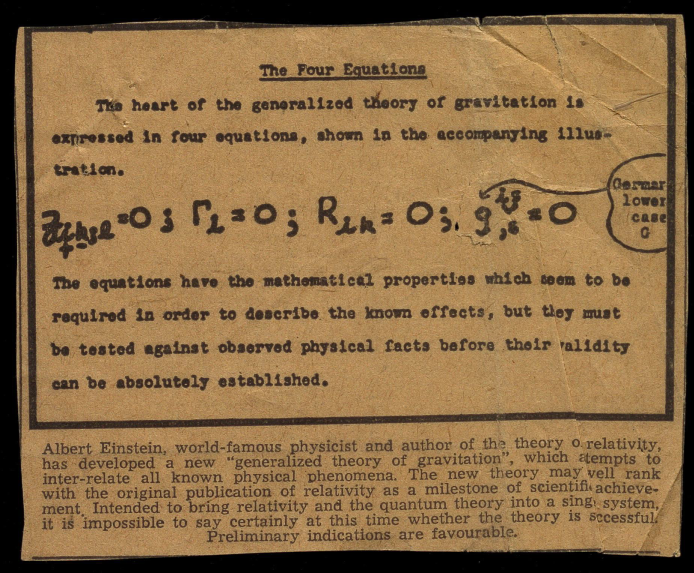
Media Clippings, bulk: 19 July 1936 - February 1955, KS Krishnan Papers, MS-024-5-2-13-3
This guide is intended as a starting point for researchers interested in exploring the role of media in Science, scientists' media relations, and how the media have covered Science in contemporary India. The resources in the Archives at NCBS on the theme include, but are not limited to, various forms of media such as print, radio, and TV, which play a crucial role in shaping culture, politics, and public opinion. It also has correspondence between journalists and scientists, as well as curated media clippings by scientists, not only about their own work but also reflecting their broader interests in Science. The collections that document how the media have covered specific scientists and scientific topics include:
1) M.S. Swaminathan Papers: In Series 6 titled Media Coverage and Event Photographs, Subseries 1 titled Coverage of M.S. Swaminathan in Print, Broadcast and Digital Media, there are several media clippings collected from the 1960s to 2018 from newspapers and magazines, tracing the public profile of M S Swaminathan and his work.
2) B.C. Choudhary Papers: In Series 3, Research references and personal collections, Subseries 6: Media Clippings, there is a variety of media clippings from the 1970s and 1980s on topics in ecology and conservation that he has collected over time, from crocodiles and snakes to birds and deer.
3) C.P. and Kusala Rajendran Papers: In Series 3, Media Clippings, Subseries 1 is Media Clippings of articles authored by C.P. Rajendran and Kusala Rajendran from the 1980s to the 2000s. These cover topics from geography and geology. It also includes popular science articles for children.
4) Usha Rai Papers: Series 1 titled Media Clippings -- Writings by Usha Rai are articles authored by her in various newspapers and cover topics related to the environment, development and welfare from the 1970s to 2010s.
5) B S Madhava Rao Papers: In Series 6: Personal and Ephemera is Sub-Series 4: Media Clippings - Miscellaneous, which contains articles on Science collected by B S Madhava Rao from the 1950s to the 1970s.
Beyond these collections, targeted folders reveal how scientists engaged with the news, tracked controversies, or used the media as a primary research reference. The Vasant Natrajan papers include media clippings on Science and Climate, as well as his direct response to another scientist, published in the news. In a folder in B C Choudhary's papers, a media clipping serves as a direct reference for studying crocodile behaviour before and during a solar eclipse at the Nehru Zoological Park. It might also be interesting to look at unpublished materials that reveal how scientists viewed the media and navigated their public relations. In MS-024 K S Krishnan papers, a letter between Cyrus Eaton and K S Krishnan talks about the Pugwash Conference's impact being covered by print media. In the MS-053 Krishna Bahadur and S Ranganayaki papers, an unsent open letter by Krishna Bahadur to the editor of The Leader narrates his side of the story regarding the research on Jeewanu and the criticism he faced from Sidney W. Fox. Additionally, there are individual folders, such as the Media Clippings in K. S. Krishnan papers from the 1930s to 1950s on Science. There are also media clippings in MS-060 Saheli papers on anti-fertility vaccine research, Depo-Provera, and Cognitive impairment.
Another interesting way to look at the theme is to examine how scientists have used broadcast technology to communicate their Science. There are several broadcast scripts delivered on All India Radio by prominent scientists, illustrating the "voice" of Science on national radio. Speakers include Obaid Siddiqi, J B S Haldane, K.S. Krishnan, B.S. Madhava Rao, M.S. Swaminathan, P.C. Vaidya, N.V. Joshi and Prakash Gole. The guide points to only one; there are many more scripts for talks in All India Radio, in various collections across the Archives.
There are also audio-visual materials documenting the history of Science on Indian television. The Chandita Mukherjee Papers include the scripts, videotapes, companion books, and episode summaries of Bharat Ki Chaap, a 13-episode series on the history of Science in India, telecast on Doordarshan in 1987. In these papers, there is also material on the establishment of a Science Channel by the Development and Educational Communication Unit (DECU) of ISRO, in collaboration with Comet Media Foundation. Another resource to look at is the oral history interviews. In one of these interviews, Vidya Athreya, an ecologist, talks about her relationship with the media. In another interview, ecologist Kamaljit Bawa discusses an increase in media savviness.
Search terms to use to find related materials (Controlled Vocabulary)
Science in mass media
Science--Popularisation
Science -- Social aspects
Science and state -- India
Science in the Public Sphere
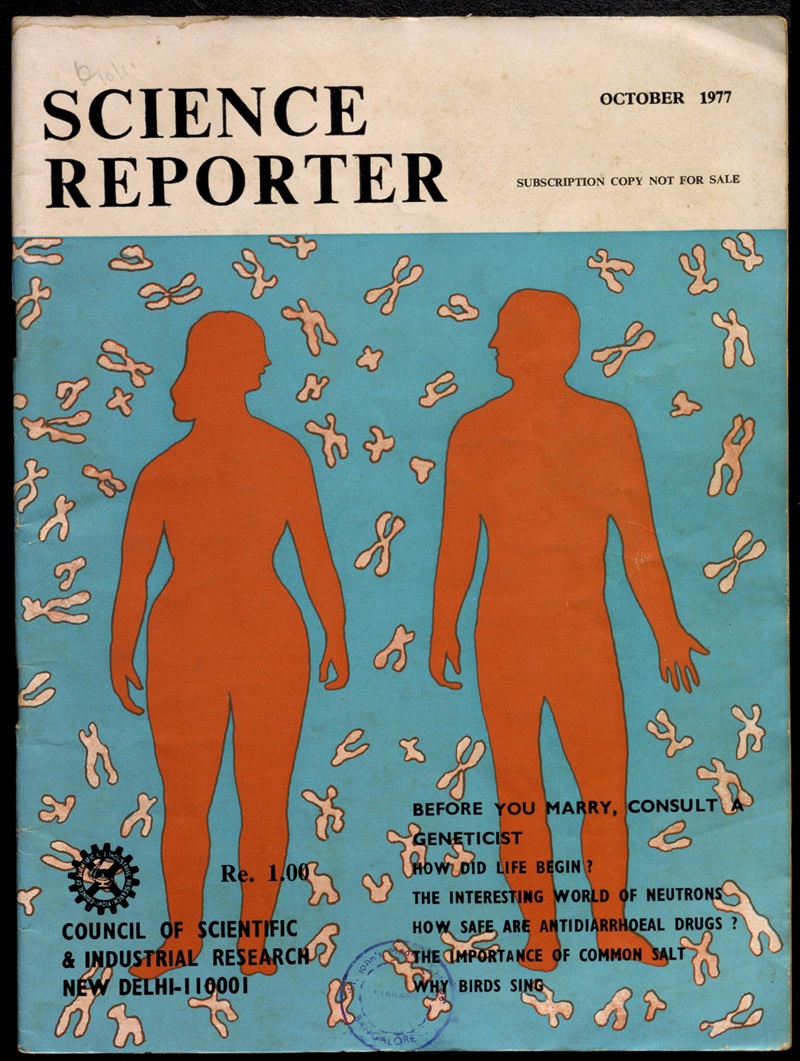
Science Reporter, Vol 14, October 1977, No. 10, Loan from St John's Library. LB-001-1-2-1-9
Jürgen Habermas defined the public sphere as a domain of social life in which public opinion can be formed and in which access is open to all citizens. In his view, the state and the public sphere are distinct and often positioned in tension with one another. In this guide, however, the public sphere is understood more broadly as the space in which information, particularly scientific knowledge, is communicated, circulated, and debated among diverse publics. Rather than emphasising its separation from the state, this guide will focus on the actors and platforms through which Science enters the public discourse. The materials span a wide range of contexts, including state-sponsored scientific literacy initiatives, citizen science projects, grassroots advocacy, public health campaigns, and environmental movements. The media also plays a significant role in this landscape; however, this has been addressed in our research guide on "Media Coverage of Science".
To begin with, the Archives at NCBS hold materials produced by government bodies aimed at disseminating scientific knowledge and fostering public discourse on what Science is and on scientific temper.
1) Science Reporter is a monthly popular science magazine published by the Council of Scientific and Industrial Research (CSIR) since 1964. It is published in English and covers articles on Science and technology. The Archives holds copies of the magazine from 1970 to 1994.
2) Swasth Hind is a monthly health bulletin published by the Central Health Education Bureau (Directorate General of Health Services) of India since 1957. It is published in English and covers all aspects of public health. The Archives holds digitised versions of individual issues and bound volumes from 1958–1994 (Source: St John's Medical College Library).
Additionally, there are folders in various collections regarding state initiatives aimed at shaping public discourse on Science. For instance, the Obaid Siddiqi papers include a folder of material on the Workshop on 'Scientific Temper' at Palampur in 2011, organised by NISCAIR (National Institute of Science Communication and Information Resources) in collaboration with Vigyan Prasar.
There are also publications by trade unions and associations that blend scientific discourse with the social and economic concerns of scientific workers. Vijnan-Karmee (1949–1991) was an English-language journal of the Association of Scientific Workers of India. Vigyan o Vigyankarmi (1970s–2021) was a Bengali social and scientific affairs journal published by the West Bengal Science Workers Association. Both publications focus on the development of Indian scientific/industrial policy and the welfare of scientific workers and feature popular articles on scientific and technological subjects. They also feature letters to the Editor from the general scientific public and association members. The Archives also holds twenty-two (22) bound volumes of the Journal of the Association of Medical Women in India (AMWI) from 1980 to 2003. The journal publishes articles focused on public health, reproductive rights, and sexual health rights of women. It also covers topics related to women's work in medicine and healthcare in India.
Another way to look at science dissemination is through publicity materials from environmental organisations and activists. The Panduranga Hegde papers include a sub-series titled Programmes, organised by Parisara Samrakshana Kendra, which consists of folders on biodiversity workshops and training camps focused on birds and wildlife. Similarly, the papers of Kalpavriksh, a non-profit organisation based in Pune, Maharashtra, India, include a series dedicated to Pune Tree Watch. It is a citizen-driven, collective initiative dedicated to protecting, mapping, and monitoring the city's urban tree cover. The publicity material here illustrates how they conveyed the Science behind their messages to citizens/public. For instance, one of their folders, titled The Green Dussehra campaign, 2007, ca 2007, shows how they employed traditions to conserve nature.
The next kind of material to look at comes from people and organisations involved in science education and science communication. The Anil Sadgopal papers are noteworthy here. One of the sub-series, titled Scientific Terminology in Indian Languages, might be of particular interest to those looking at the communication of science in languages other than English. The Navnirmiti papers contain materials of the not-for-profit social enterprise, located in Pune, Maharashtra, which commits itself to popularising science in India through its science communication, publication, and education initiatives. The Krishna Bahadur and S Ranganayaki Papers hold materials on science education, reflecting their roles as educators before becoming researchers. It contains an entire Sub-Series on Science Education, with the majority of the materials in Hindi. The P C Vaidya Papers also include material on Science and Mathematics Education. P C Vaidya was an astronomer and a mathematician, and, like the previously mentioned researchers, he considered himself more an educator than anything else. The series on Science and Mathematics Pedagogy exemplifies this commitment. In this series, noteworthy is the volumes of Suganitham, a Gujarati-language mathematics magazine focusing on educational content, problems, and articles related to mathematics.
This is not an exhaustive list. If you want to find more related materials, you can use these search terms in the catalogue (Controlled Vocabulary)
Science Education
Science and state -- India
Education and state
Communication in science
Science and society
Science--Popularisation



