
Subject Guides
Rev 1: Feb 25, 2026
Authors: Parvathy V and Sanjna GY
Agricultural Sciences
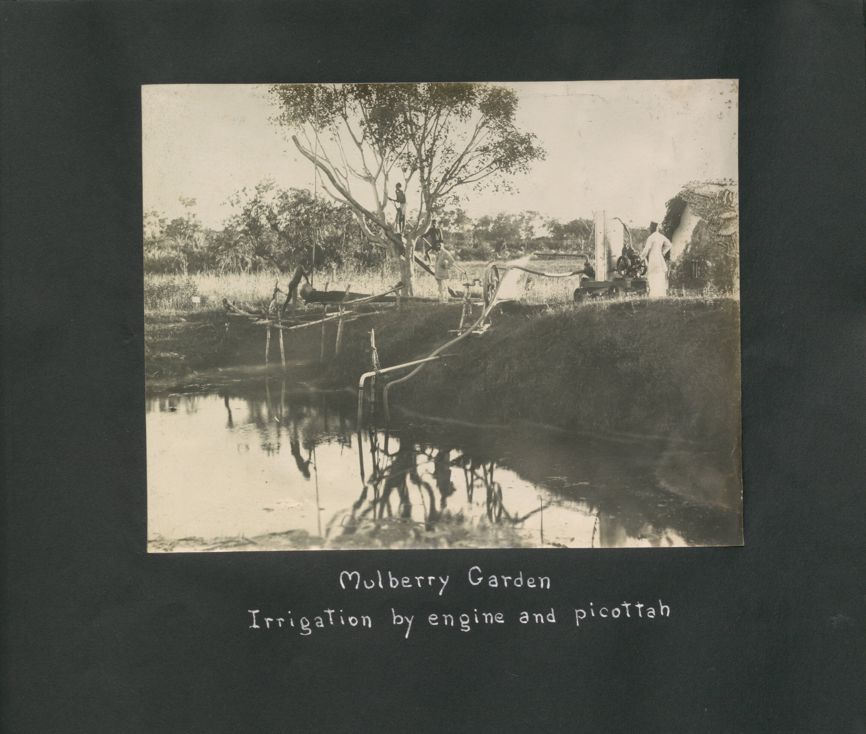
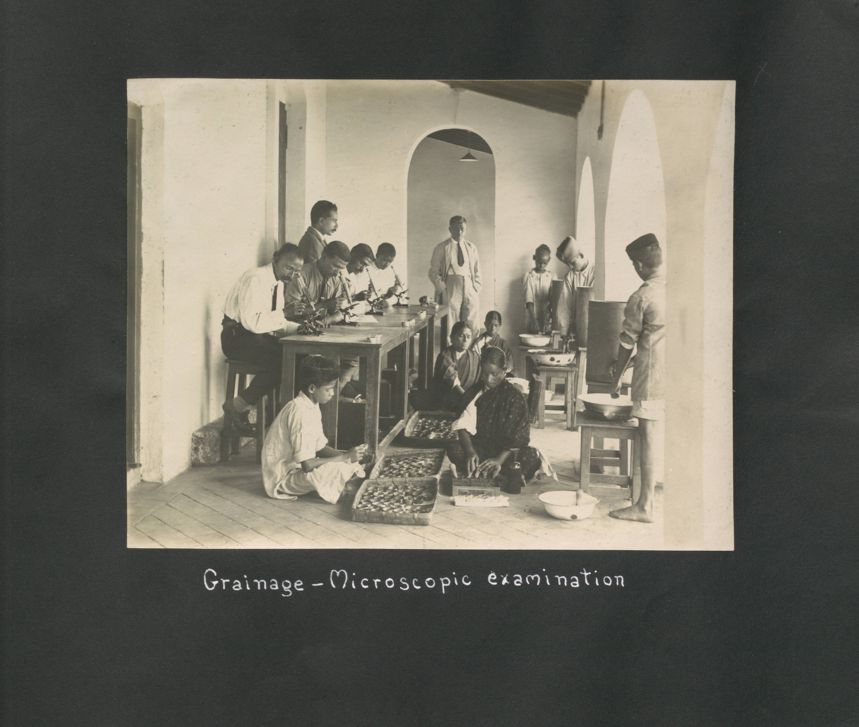
Photos from album titled ‘Mysore Sericulture Department, MS-012-5-1-4-1, Leslie Coleman Collection, 1925, Archives at NCBS
The histories of agricultural practice post-Independent India are often anchored in the Green Revolution. The collections at the Archives at NCBS enable researchers to both go further back in time to trace the precedents of the Green Revolution while critically examining dominant narratives around it.
The collection of Leslie C. Coleman holds material from 1914 to 1955. Coleman’s career as an entomologist and mycologist in the princely state of Mysore speaks to practice, research and education in agriculture in pre-independent India. The material shines a light on how localized, regional practices of food cultivation intersected and interacted with colonial expertise to give rise to “agricultural sciences”. Research reprints and the photographic material within Coleman’s collection enable exploration on how transformations in farming practices through early efforts of mechanization occurred (also seen in the cover image to the guide above). We also get a view into the early nature of scientific field experiments carried out in collaboration with farmers in agriculture on a variety of crops including sugarcane, coffee, arecanut and millets. Coleman’s material also reflects his involvement in establishing agricultural institutions for education and training such as the Mysore Sugar Factory in Mandya, the Central Coffee Research Station in Balehonnur and the University of Agricultural Sciences (UAS), Bangalore. In particular, the continuities and divergences within the University of Agricultural Sciences from Coleman’s time to post-independence can be traced through the material in the collection titled Small Donations - Agricultural Sciences. Consisting of material of three scientists - K Chandrashekhara, S Subramanya and H R Arakeri - this material allows a glimpse into textures of institutional change and the evolution of these institutions in India.
Moving to the post-independence era, the Archives at NCBS is home to the papers of M.S Swaminathan, which is one of the largest collections housed in the archives. The Swaminathan papers give us insight into the fragmented histories of agriculture starting in 1940. While the bulk of the material consist of the private papers of MS Swaminathan, the collection contains a series containing institutional material related to B.P Pal and the history of agricultural institutions such as the Indian Agricultural Research Institute (IARI) and the Indian Council for Agricultural Research (ICAR) - prior to Swaminathan’s directorship of the institution. The curation of print media of the Swaminathan papers allows us to create a timeline and contextualize his trajectory in the wider socio-political milieu of his time. The Swaminathan papers contain a vast corpus of records from government bodies of the Indian Government, including the Planning Commission at two different points. In addition to this domestic focus, Swaminathan’s career spanned a number of international organizations such as the International Rice Research Institute ( IRRI), the Food and Agriculture Organization (FAO), World Wildlife Fund (WWF) and IUCN (International Union for the Conservation of Nature). In capturing these institutional engagements, the administrative series allows us to trace transnational flows of aid, expertise and personnel that shaped the landscape of Indian agriculture. This material allows us to see how Swaminathan’s influence spanned from the intersection of research and policy in agriculture, conservation to even space and health policy.
Three collections complement the Swaminathan papers in providing a different vantage point to critically examine the Green Revolution. The first is the oral history collection created in collaboration with the Foundation for Agrarian Studies. The collection comprises of oral history interviews with scientists including Swaminathan and his contemporaries. This allows us to move past a singular vision of the Green Revolution and understand the broader network of scientists who steered scientific change. The second is the University of Jammu STEM Pamphlets and Papers. These include leaflets, pamphlets created by the Ministry of Food and Agriculture now Ministry of Agriculture & Farmers Welfare and by the Indian Council of Agricultural Research (ICAR). Dealing with farming and propagation techniques for various crops, this material was intended for public dispersal amongst farming communities. They enable investigation into visual histories of the Green Revolution - prompting questions on the interaction between state machinery and the public through various forms of state propaganda in the decade between the 1960 - 1970. The third collection Fr. Leo D’ Souza can also be examined through lens of the Green Revolution but extends far beyond it. A Jesuit priest who pursued doctoral studies at Max Planck Institute for Plant Breeding Research in , D’Souza was most well known for his research on cashew. His biographical material, oral history interviews and the related St Aloysius Mangalore Papers together reflect on his interactions with MS Swaminathan, his experiments in test-tube cultivation of cashew at his laboratory in St. Aloysius College in Mangalore and the intersections of science, gender and religion.
The Archives at NCBS is situated within the campus of the National Centre for Biological Sciences, which was built on land donated by the University of Agricultural Sciences. This gives the Archives a unique position to investigate the histories of agriculture science. We welcome efforts by researchers to weave further threads of connection between collections and shape how the collections can grow.
Search terms to use to find related materials (Controlled Vocabulary)
Agriculture -- India
Agricultural innovations
Agricultural policy



